

Julian Assange extradition hearing begins at Old Bailey
The WikiLeaks founder, Julian Assange, has appeared at the Old Bailey at the start of an extradition hearing on an 18-count US indictment that accuses him of recruiting hackers to steal military secrets.The WikiLeaks founder, Julian Assange, has appeared at the Old Bailey at the start of an extradition hearing on an 18-count US indictment that accuses him of recruiting hackers to steal military secrets.
Wearing a dark suit, tie and white shirt, Assange, 49, sat behind a glass security screen at the back of the court, his glasses pushed back on top of his head.
Before coming into court, he had been formally rearrested on the new US indictment which updates and broadens previous charges. All but one are for violations of the country’s Espionage Act. Asked whether he was prepared to consent to be extradited to the US, Assange replied: “No.”The district judge Vanessa Baraitser commented: “That was the response I was anticipating.” There were no opening statements by either parties. The indictment says Assange and WikiLeaks “repeatedly sought, obtained, and disseminated information that the United States classified due to the serious risk that unauthorised disclosure could harm the national security of the United States”.It said: “Assange designed WikiLeaks to focus on information restricted from public disclosure by law, precisely because of the value of that information.
“To recruit individuals to hack into computers and/or illegally obtain and disclose classified information to WikiLeaks, the WikiLeaks website posted a detailed list of ‘The Most Wanted Leaks of 2009’, organised by country.” At the start of the hearing, both sides released detailed “skeleton” arguments, setting out their legal claims. The one submitted by James Lewis QC, acting for the US authorities, runs to 99 pages along with the 48-page “second superseding indictment”. The two-part skeleton argument written by Edward Fitzgerald QC, representing Assange, runs to almost 200 pages.
In his submission, Lewis accused Assange’s lawyers of conducting a defence consisting of “an attack upon the president of the United States [which] ignores the institutional competencies of the agencies relevant to this case, the constitution of the United States and the independence of its courts”. It also said the defence was inaccurately “treating Assange as though he were engaged in reporting, in the same position of any journalist who comes into possession of classified information”.
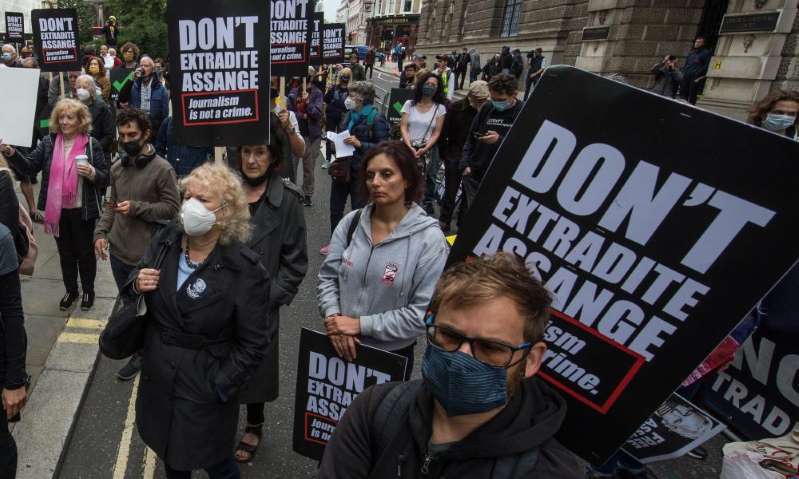
Fitzgerald’s submission asserted that the prosecution was “being pursued for ulterior political motives and not in good faith”. He added: “The [US] request seeks extradition for what is a classic ‘political offence’. Extradition for a political offence is expressly prohibited by article 4(1) of the Anglo-US extradition treaty. Therefore, it constitutes an abuse of this court’s process to require this court to extradite on the basis of the Anglo-US treaty in breach of the treaty’s express provisions.”
Fitzgerald argued the US authorities were misrepresenting the facts “in order to bring this case within the bounds of an extradition crime” by suggesting Assange had materially assisted the US whistleblower Chelsea Manning in accessing national security information, and that there had been a reckless disclosure of the names of particular individuals. Explaining the short delay to the start of proceedings, Fitzgerald said this had been the first time in six months he had managed to see his client.
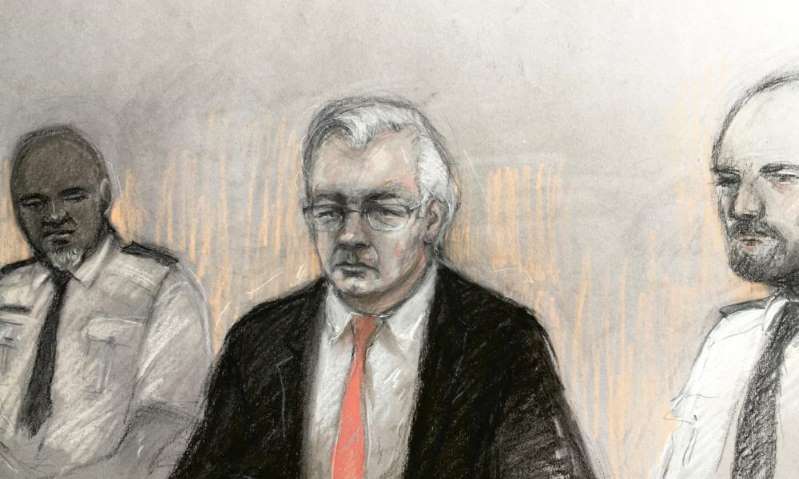
The case is being heard at the Old Bailey in London with lawyers, observers and the media spread out across several other courts listening to proceedings via video link. Mark Summers QC, for Assange, said the late serving of the new US indictment was “abnormal, unfair and liable to create real injustice”. The additional material had appeared out of the blue, Summers said. It presented extra allegations of criminality which it claimed on their own might be separate grounds for extradition such as stealing data from banks, obtaining information on tracking police vehicles, and supposedly “assisting a whistleblower in Hong Kong”.
“This is essentially a fresh, extradition request,” Summers added, presented at short notice at a time when Assange has been “inhibited” from speaking to his defence lawyers.Summers said: “We believe the US saw the strength of the defence case and thought they would lose [so introduced the additional material].” He asked the judge to “excise” or dismiss the belated, extra US indictments.
But Baraitser dismissed the defence request, saying she had previously offered Assange’s lawyers an opportunity to adjourn the hearing to give them more time to deal with the new US indictment. That had been declined. The issues of fairness could be raised during the hearing in the coming weeks, she said.The hearing continues.Julian Assange extradition hearing begins at Old Bailey
Reference: Owen Bowcott Legal affairs correspondent 12 hrs : 07/09/2020